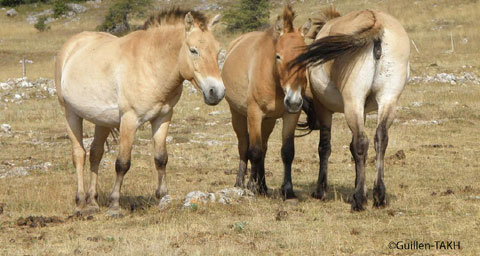
The last wild equine, the Przewlski horse almost ended up forever behind zoo bars. Thanks to the NGO Takh, a herd is once again roaming the Mongolian steppe.
It was an audacious gamble. To recreate a herd of wild equids with a species that only existed in zoos in the early 70s. Yet this was the feat achieved by the Takh association, founded by Claudia Feh in 1990. Today, in western Mongolia's Khomiin-Tal region, a wild herd of Przewalski is once again galloping across the steppe. The last wild horse in the world, the Przewalski (takh or takhi in Mongolian), which you may have seen on the walls of the Lascaux caves, once roamed the plains of Central Asia and Europe. Discovered in 1879 by Colonel Przewalski in the Gobi Desert, at a time when scientists thought they had inventoried all mammals, it soon attracted a great deal of attention and soon found itself behind zoo bars.
Last seen
To capture a horse," explains Hélène Guillen, administrative and financial manager of the NGO Takh and the Villaret site, "zoo managers could kill the whole herd, because the horses would defend themselves against each other.
Human predation was compounded by strong competition from domestic herds and Mongolia's harsh winters. The last individual was spotted in 1969. Thereafter, Przewalski's horse was only seen in wildlife parks.
Three years after the creation of the Takh association, eleven Przewalski's horses from zoos were reintroduced into a 400-hectare park at Le Villaret in the Cévennes, with a view to their subsequent release in Central Asia. At the time, there were other reintroduction programs for the last wild equidae. But Claudia Feh's approach is different from that of other projects involving direct transfers of specimens from zoos to Mongolia.
"The Takh association provided for a period of adaptation," emphasizes Hélène Guillen. For ten years, the horses were left to their own devices, with no controls. In semi-liberty, they gradually recreated a herd and rediscovered the behaviors of their ancestors.
"Some of them had always been fed hay and had never grazed. Despite this, they rediscovered their instincts, and were soon eating the short grass of the Causse Méjean.
Causse and steppe have much in common
 The horses have reconstituted a family structure, with its own rules. They became wild again. By 2004, members of the NGO felt they were ready to face the steppe and Mongolian winters.
"There are similarities between the conditions of the Causse and the steppe. The summers are hot and dry, and the winters harsh and long. The horses were able to readapt to the snow," notes Hélène Guillen. But there was more to it than that. Mongolian winters are harsher than those on the Causses. Were the herds able to withstand temperatures of -50°C? to defend themselves against large predators like wolves?
The reintroduction was carried out by family, with a stallion, mares and their offspring. "It was very important not to separate individuals who had created close bonds that united them."
Vingt-deux chevaux ont été transportés, par avion entre 2004 et 2005. Les animaux ont été relâchés dans un site clôturé d’environ 14 000 ha. Pour mener à bien la ré-implantation de cette population, l’ONG se place dans une « approche paysage » ainsi que le recommande la convention sur la biodiversité, signée à Rio en 1992.
Nomads are part of the program
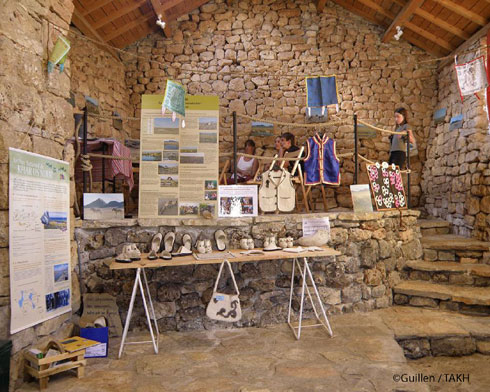
La population nomade de Khomiin Tal a toujours été associée au projet. Aujourd’hui, Takh mène un projet sur le « développement communautaire ». « Nous essayons de développer des activités alternatives à l’élevage comme source de revenus pour les locaux. Par exemple, nous vendons au Villaret des objets en feutre fabriqués par les femmes de Khomiin Tal, souligne Hélène Guillen. Nous souhaitons permettre aux éleveurs de tirer des revenus autrement que par la laine cachemire. »
A long terme, pour que la population de chevaux se multiplie et trouve suffisamment de ressource alimentaire, il faut que le pâturage soit suffisant pour accueillir les chevaux sauvages mais aussi les troupeaux domestiques. « Nous cherchons donc à trouver des moyens pour les éleveurs d’adapter la taille de leurs troupeaux à l’état du pâturage, tout en tirant des revenus stables.
Nous organisons aussi chaque année une « summer scholl » destinée aux enfants durant leur période de vacances, et avons dégagé des financements pour mettre en place une centre de soins médicaux à Khomiin Tal. »
Un ecovolunteering program
Since 2010, Takh has been calling on ecovolunteers. Currently, one volunteer is on site in Mongolia to observe the herd. This summer (2010) two volunteers are present in July and two in August at Le Villaret. Their role is to guide tourists and raise their awareness of the Przewlski horse's destiny.
Laurence Dupont
Przewalski's horse association : Takh
Tour du Valat
Le Sambuc
13200 ARLES
Tel: + 33 (0) 490 97 23 13
www.takh.org